
AI Efficiency vs. Brand Soul: Understanding the “Uncanny Valley” in AI Marketing
In the last few years, artificial intelligence has transformed marketing. Brands can now generate ad copies, product descriptions, social media posts, and even full campaigns in seconds. AI brings speed, scalability, and cost efficiency that traditional creative processes often cannot match.
But there’s a growing concern among marketers and consumers alike: When everything is optimized by AI, does branding start losing its soul?
This question leads us to an interesting concept called the “uncanny valley” of AI marketing.
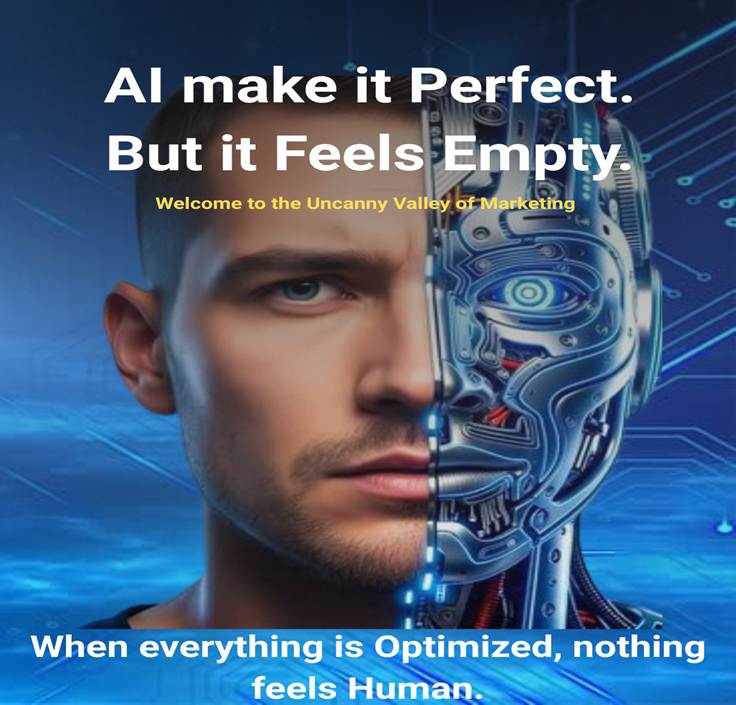
What is the “Uncanny Valley” in Marketing?
The term uncanny valley originally comes from robotics and psychology. It describes the uncomfortable feeling people experience when something looks almost human but not quite.
In marketing, the same thing is starting to happen with AI-generated content.
AI can write posts, design ads, and generate visuals that look very close to human-made creativity, but sometimes they feel slightly off. The tone might be technically correct but emotionally flat. The storytelling might be structured but lacks depth. The campaign might look polished but feels generic or soulless.
Consumers may not always know the content is AI-generated, but they can sense that something feels too perfect, too formulaic, or too impersonal.
That’s the uncanny valley of AI marketing.
Why AI Makes Marketing So Efficient
AI tools are incredibly powerful for marketing operations. They help brands:
- Generate large volumes of content quickly
- Personalize marketing messages at scale
- Analyse customer data faster
- Reduce campaign production costs
- Test multiple creative variations instantly
For performance marketing and operational tasks, AI is extremely effective. It allows brands to move faster and compete in crowded digital environments.
However, efficiency alone doesn’t build strong brands.
The Risk: When Efficiency Replaces Emotion
Great brands are built on emotion, identity, and cultural relevance. These elements are difficult for AI to replicate.
AI learns from patterns in existing data. That means it often produces content that feels predictable and safe, rather than bold or original.
As more brands start using the same AI tools, marketing begins to look similar across companies. Campaigns become optimized but less distinctive.
This creates a problem:
- The content is technically good
- The message is clear
- The design looks polished
Yet the brand doesn’t feel memorable.
This is where the “brand soul” starts disappearing.
The Brands That Will Win
The future of marketing is not AI vs humans. It’s AI + human creativity.
Smart brands are using AI for efficiency while protecting the emotional core of their brand.
For example:
- AI can generate draft content
- Humans refine storytelling and tone
- AI can analyse performance data
- Humans create bold creative ideas
In this model, AI becomes a tool for speed, while humans remain responsible for meaning, culture, and emotion.
The Real Balance
AI is changing marketing forever, but brands that rely only on automation risk falling into the uncanny valley of creativity where everything works, but nothing truly connects.
Efficiency builds reach. But soul builds brands.
The Key Insight
Automation improves efficiency. But conversions depend on emotion, relevance, and trust.
The best marketing systems use automation for Data analysis, Workflow management and Content drafts. And rely on humans for Storytelling, empathy and brand voice. Because in marketing, speed attracts attention but authenticity closes the sale